
Take a Picture

The polymath François Arago considered photography ‘the discovery which could contribute so much to the progress of art and science.’ And indeed it has. Born of the industrial revolution, the creation of photography was rooted in practicality and automation: a quick way to capture the present moment. Whereas it took painters months to depict a scene, with the camera obscura it took hours. Pre-history has shown man’s progress to be rooted in innovation and methodical trial and error, the pillars of both art and science. From Louis-Jacques-Mandé Daguerre to Sir John Herschel, the founders of photography were equally versed in both science and art; all the more poised to discover and master a method that required the seamless integration of both disciplines in recording the evolution of man.
What are the stories we tell ourselves? Why do we tell them? Is what we see in reality different from what we imagined? And as the rods and cones register in our brains, do the images before us morph at fractions of seconds we do not see? To that last question, I firmly answer yes. Out of all the visual artistic disciplines I love photography most of all because it is the most honest. Even in the manipulation of an image one is telling a story. We live in a time when everything needs to be questioned, from the stories we read to the images we see. In the artificiality of our moment, the narrative of our time is being told; A time of miseducation, propaganda, surreality and fantasy, seen in the endless deluge of images that parade across our screens and mind. In the pitch-perfect lives we post on social media, we are screaming for connection, begging for someone in the ether of the world wide web to validate us. The filters we use to augment, enhance, and airbrush our cyber appearances have seeped into the real world, causing us to alter ourselves so we may resemble the image. The tables are turning and no longer can we differentiate between the chicken and the egg.
In its nascency, photography was used to document expeditions, construction and the way people lived. Man had effectively discovered a way to visually document the passing of his time. We may poo—poo the endless pics of food, clothes and random esoterica on view, but these images are in the moment documents of our vapid times. When beings of the future look back at the endless minutiae recorded, they’ll have a clear picture as to why our age was as unstable and hopeless as it is. We know who we are, because we saw that they were. Yet, this in no way preludes a doomed fate—we are human beings after all, the OG cockroach--instead it is a message in a bottle, a warning echo that as we sit in the fix, we must check ourselves.
Like science, art documents the advancement of man. Where we started, where we’ve been, where we are and where we’re going. As technology hurtles the human race forward in an unknowable direction, it’s essential we take the moments to pause document and reflect. Photography is the artistic discipline of our time. With every technological advancement, the photographic process evolves. What once took up a room now fits in the sliver of our pockets, a trait I consider to be priceless because right now, today, we need the accessibility and ease to take snap what’s going on around us. These times they are changing, yet we need to stop, look and let the light in.
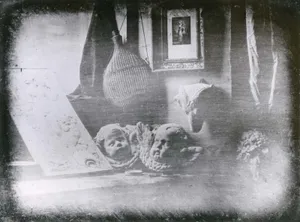
Image: Louis Daguerre 'Daguerreotype of Interior'

