
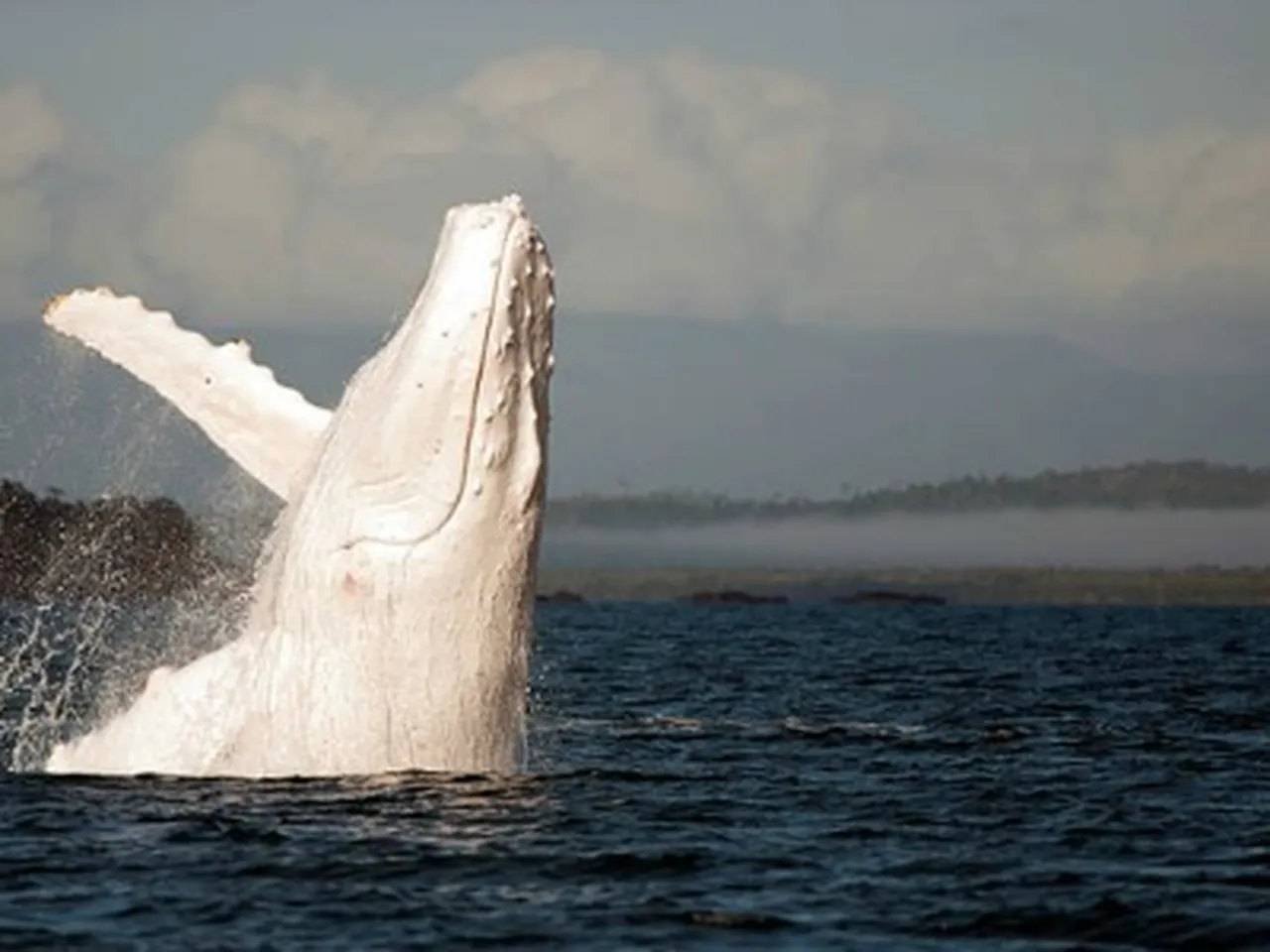
The White Whale

It’s a perfect summer late afternoon. I’m sitting on a bench watching the glorious nothingness of life go by. The trees stand tall and bright, the bushes adding various shades of green to the floral palette. In the distance, children scream on the multi-coloured playground, chasing each other with unbridled glee. A pink balloon floats up into the trees, a casualty from a first birthday bundle. I’m breathing calmly, there is no tightness in my chest, my stomach is not somersaulting. I am simply here; my two bare feet firmly planted on the stone paved walk. Welcome back, Maryam. It’s been too long.
*
We do what we do because we must. For some thoroughly unknown reason, we get up and do it, every day, all the time. In waking, sleeping, slumbering and brimming, we think on it and do it. We slog till our senses go numb in search of that goddess victory. Really, it’s torture. Too often what we’re making comes at a great cost to ourselves. We lose family, we lose money, we forgo security, for a pie in the sky we work to make appetizing. It’s a wish, a hope, a dream. A fantasy that other’s watch us pursue with pity. Faith makes us look like fools, yet we keep going.
Disclaimer: I have not read Moby Dick. My senior year in college I had two options for my thesis: Hermann Melville’s tome or a semester on reworked classics. I chose the latter and found myself reading one of the 21st century’s most overrated and trivial books: Elizabeth Kostova’s The Historian. I couldn’t believe I was spending my final year in university as an English Major reading a book that had absolutely no literary value and quite rightly perished in the receptacle to which it should have remained. Thoroughly annoyed, during our thesis presentation I righteously proclaimed the semester a waste of time, that instead of reading actual works of notable literature we were reduced to this drivel. How did I pass? By choosing to compare that piece of shit with a classic epistolary tale: Bram Stoker’s Dracula. A book of such intriguing lore, told through a unique lens that to this day, its execution never ceases to amaze me. Unbeknownst to myself, I was well on my way to being a writer.
How do you tell a story? Honestly. You discover your theme and write the way you feel it being heard. It’s a little bit of hocus pocus, mumbo jumbo, but many an artist will tell you that’s how the impetus appears. You have a spark and let it manifest in the primordial soup of your unconscious. Stoker’s gothic tale may not be high-brow literature, but it’s great writing for the sole reason that it enraptures. With every account you want to know what comes next; was how this narrator saw it, the same as how another interpreted it? Will she? Won’t she? Questions one would ask just as easily about a piece of art as one would life.
What came first, the whale or the desire? Watching Robert Wilson’s operatic adaptation of Moby Dick, I pondered this ponder. Was Ahab born a dreamer or did he become one upon first encountering the white whale? From the moment the mighty mammal rose from the sea and dove into the Pequod, splitting it in two and returning to the depths from which it came—Ahab’s leg safely in tow—did the sailor know his life’s purpose had been set? We never know do we? Did Adam know his eternal quest for his lost rib would result in men’s inability to be monogamous? You never know what’s happening until it’s happening, over and long gone. And I think that’s what Wilson’s ultimate message in his staging of the classic is.
The opera was a visual delight and musically adventuresome, with Anna Calvi’s synth-rock score aptly suited to the thunderous waves of the uproarious seas. Sung in German, after a while from line to line I had to cast my eye on the supertitles to be completely sure I was following the story straight because the story would go a bit here and there. For the most part I was, which is why it was a little bit of a letdown to realise Wilson didn’t plunge particularly deep in his interpretation. We all know the Sparknotes version of the book, so new insight was invited. Visually striking: absolutely (except for the the ill-advised old-timey video of depressing looking seaside dwelling townsfolk). Odd little manboy running around in short pants: confusing. In the end, the profundity of seeing the opera came in my gratitude for reintroducing me to a much-parodied doorstop of a book.
For me, seeing Moby Dick on May 2nd, would be the last day I’d ever be the same. For a long time, I’ve been chasing something. A feeling, a belief, a phantom. A reason for why I survived and how do I exist. On May 1st, I purposefully—yet unknowingly--set into motion a series of events that led me to find my self. For much of my adult life, my actions have been dictated by others. What I’ve wanted to do has sort of come first, but never to the full extent that I could be truly successful. Really, my wants and needs have come second to what those I trusted thought was best for me. That kind of living fucks you up, leaving you with a false sense of self. A husk that when a mighty wind blows, you disintegrate like a cobweb in mid-flight. It wasn’t until a few years ago that I began the long, painful journey of reclaiming my leg. Yet, it’s never been quite right, and the phantom of what once was has haunted me even as I tricked myself into believing it was there. It took the continued violent strikes of a sledgehammer to what remained of my solid body, for me to wake up and cease chasing something that could never grow back, but be replaced. In these months since my seeing of the opera one image remains firm in my mind: Captain Ahab dressed in all white with a shiny black stiff peg-leg and white cane. He’s got a new leg and his life can continue with good mobility. That he chooses to chase what’s gone is his choice to make, a decision I now realise I will not make.
Hermann Melville died with not much to his name. He worked as a middlingly paid civil servant until his death, his greatest book not in print. I am a writer, but I will not die without accomplishing the other successes I intend to reach. The rhetoric of this modern age—and perhaps it’s always been said—is that we artists have to live in penury to be true to our craft. That all our focus has to be in our creation and a full-time ‘normal’ job will derail us. I remember being told that by a theatre teacher and for years I kept that in my heart as I worked shitty job after shitty job striving for the artistic breakthrough of fame, all the while I was becoming smarter, more creative and more powerful as those I was professionally surrounded by went nowhere. ‘But I’m an artist,’ I’d tell myself, ‘this is the struggle.’ Not for me it isn’t. Not anymore. I’m a great writer, but I’m also a fucking devastatingly brilliant businesswoman. Destroying my whole true self for an antiquated notion perpetuated by those who are not me, I will not continue. I cannot. I’ve been given the chance to walk again, what a slap in God’s and my face would it be if I did not take advantage of this second chance? The accomplishments I leave behind will tell my story, not someone called Ishmael.

